There’s a moment many founders reach that it’s hard to explain out loud.
The company is growing. The team is capable. The numbers look fine. From the outside, things appear stable, maybe even successful.
But internally, something feels off.
The business demands attention in a way it didn’t before. Decisions linger longer than they should. Even small issues seem to pull the founder back into the center. Time off doesn’t feel restorative, because the system still depends on your presence to function well.
Nothing is “wrong.” And yet, it doesn’t feel right.
This is usually the point where founders assume the problem is personal. They’re not delegating enough. They’re holding on too tightly. Or they simply need to push through another phase.
In reality, the issue is rarely about effort or control. The real question is what the company is designed to require.
When ownership turns into obligation
Early-stage companies need founder intensity. Speed, judgment, and intuition are advantages. The founder is close to everything, and that closeness creates momentum.
The problem is that many companies never outgrow that dependency.
As the organization scales, responsibilities shift, but the gravity doesn’t. Decisions still pull inward. Context still lives at the top. The founder becomes the default problem-solver, not because they insist on it, but because the system quietly expects it.
Over time, ownership begins to feel less like leverage and more like obligation.
Founders often respond by hiring more people, adding layers, or formalizing processes. These changes can improve stability, but they don’t always reduce dependence. In some cases, they increase it.
The company becomes more complex, not more self-sustaining.
Why stepping back rarely works the way founders hope
At this stage, many founders try to step back.
They reduce involvement, delegate more aggressively, or adopt a hands-off posture. In theory, this should create space. In practice, it often creates anxiety.
The business still needs decisions. Momentum still needs direction. When the founder disengages without redesigning the system, gaps appear. Teams hesitate. Execution slows. The founder ends up reinserted, not by choice, but by necessity.
This is why “letting go” so often feels like abandonment rather than freedom.
Independence doesn’t fail because the company resists it, but because the system was never built to support it.
The real constraint isn’t time, it’s structure
Founders frequently describe this phase as a time problem. They don’t have enough of it. Their calendar fills faster than they can clear it.
But time is a symptom, not the cause.
The deeper constraint is structural. The company requires ongoing founder input to maintain clarity, velocity, and coherence. Without that input, motion degrades.
As long as the founder remains the primary stabilizing force, the business can’t truly run without them, no matter how talented the team is.
This is the point where many founders quietly accept that pressure is simply the price of leadership. It isn’t.
Designing for momentum instead of dependence
There’s another way to think about this stage of growth.
In physics, systems that rely on constant force eventually exhaust their source. Systems that sustain motion do so because of how they’re designed, not because something keeps pushing them forward.
Companies work the same way.
When momentum is built into the structure of the business, through clear decision logic, durable priorities, and cultural alignment, the founder stops being the stabilizer. The system begins to hold.
This doesn’t remove the founder from the equation. It changes their role.
The founder becomes a point of orientation rather than a source of propulsion. Present, but not pressured. Involved, but not consumed.
Naming the shift
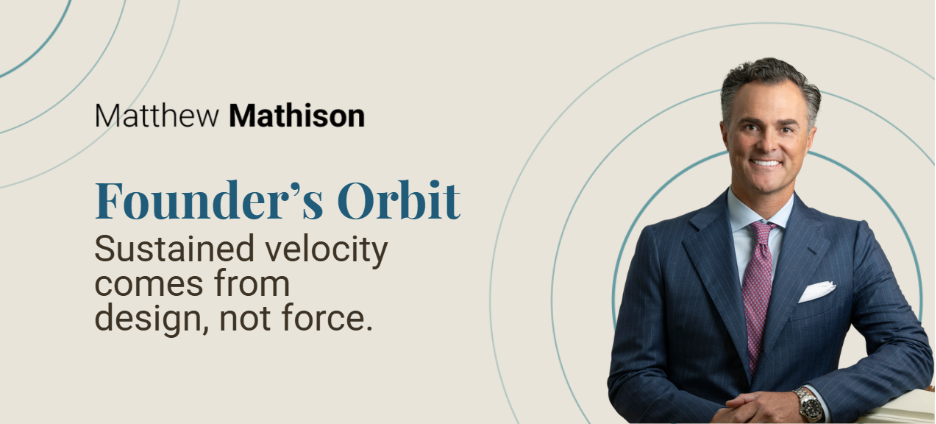
I use the term Founder’s Orbit to describe this transition.
Founder’s Orbit moves beyond stepping away or becoming passive. It focuses on designing the company so momentum no longer collapses without your constant involvement.
When founders reach this state, a few things change.
The business stops pulling them back into the middle. Decisions resolve faster, not because the founder approves them, but because the system makes direction obvious. Teams move with confidence because they understand what they’re protecting, not just what they’re executing.
Most importantly, the founder’s energy is no longer the limiting factor.
Why this stage often goes unnoticed
This transition is rarely discussed because it doesn’t fit clean narratives.
Business advice tends to frame growth as either hustle harder or let go completely. Founder’s Orbit sits in between. It requires design, not detachment. Presence, not pressure.
That makes it harder to package and easier to miss.
I’ve experienced this tension firsthand, operating businesses while managing capital and people at scale. The lesson wasn’t about working less. It was about seeing where effort was compensating for missing structure.
Once that becomes clear, the work shifts from personal endurance to system design.
Seeing your company differently
If this perspective resonates, Founder’s Orbit is where the idea comes into focus.
Founder’s Orbit is a way of understanding how companies move beyond founder burnout and bureaucratic drag by designing for momentum instead of constant force. It reframes scaling as a physics problem, not a personality problem, and helps founders see whether velocity lives in the system or still depends on them to hold it together.
The experience is designed to clarify what your company is built to require from you and what has to change for founder-level velocity to become structural.
Sometimes progress begins with seeing the system you’re already inside more clearly.


