If you’ve been paying attention to the conversation around scaling, you’ve probably seen it framed as a choice: Founder Mode or Manager Mode.
Stay in Founder Mode and you preserve speed, intuition, and quality, but everything runs through you. Shift into Manager Mode and you build structure, process, and hierarchy, but over time, the thing that made your company feel alive starts to fade.
Both sides make valid points. And yet, for many founders, neither path actually delivers what they’re hoping for.
Because the problem isn’t about which role you choose.
It’s about what the company requires from you to keep moving.
When Growth Starts to Feel Heavier
I’ve worked with founders who are doing “everything right” on paper. Revenue is up. The team is in place. The business looks stable from the outside.
And yet, they’re tired in a way rest doesn’t fix.
Decisions feel heavier. Delegation technically works, but something feels off. The company keeps growing, but instead of creating leverage, it seems to demand more attention, more energy, more presence.
Nothing is broken in an obvious way.
But something isn’t working the way it should.
Why Both Founder Mode and Manager Mode Fall Short
Founder Mode works because the founder is the engine. Speed and quality stay high, but momentum depends on constant personal effort. Over time, the founder becomes the bottleneck, not from lack of skill, but because the system can’t hold on its own.
Manager Mode replaces effort with structure. Control improves, but velocity often fades. Decisions slow; culture stiffens, and the founder steps back without ever feeling free.
Both approaches rely on continuous energy input. They pull from different places, but neither solves the core problem: the company isn’t designed to sustain momentum without being pushed.
A Different Way to Think About Scale
This is why the debate keeps looping. Founders bounce between extremes, assuming the answer must exist somewhere along that line.
What’s missing is a different way to think about scale altogether.
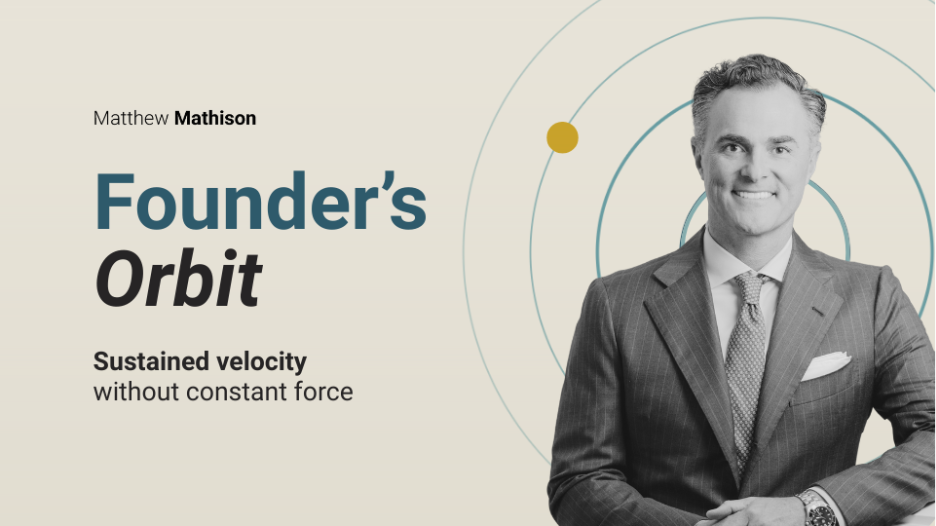
In physics, orbit occurs when an object reaches enough velocity that it no longer needs constant force to stay in motion. The system itself sustains movement. Gravity does the work.
The same idea applies to companies.
When a business is designed to hold momentum on its own, the founder no longer has to supply constant thrust just to keep things moving.
When Momentum Is Designed Into The Company
When momentum is built into the system, a few things begin to change, often quietly at first.
Decisions stop bottlenecking at the top. Teams don’t just execute tasks; they protect momentum. Culture becomes a stabilizing force instead of something that needs constant reinforcement. The founder is still deeply involved, but no longer functioning as the primary fuel source.
This way of building is less visible because it doesn’t fit neatly into common advice. Business media tends to reward extremes. Advisors often optimize for efficiency or control. What gets overlooked is the middle ground, where velocity is preserved without constant effort.
I use the term Founder’s Orbit to describe this state. Not as a framework to follow, but as a way of seeing how companies can sustain founder-level velocity without requiring founder-level energy.
Once founders see this pattern, the usual debate between Founder Mode and Manager Mode starts to feel incomplete. The real question isn’t which role to choose, it’s whether the company is designed to hold momentum on its own.
An Invitation to See It More Clearly
I’ve had to operate in both modes at the same time, running businesses while managing capital and people at scale. That tension is what forced me to see the system underneath the roles.
Founder’s Orbit is the language I use to describe that system.
If this perspective resonates, I put together a short, eight-minute training that expands on the idea. It walks through how founder-level velocity is created, how it’s sustained, and how to recognize whether your company is designed to support it.
You can explore Founder’s Orbit here.
Sometimes progress doesn’t come from choosing better options.
It comes from seeing the system you’re already inside more clearly.


